Grade II Listed Building Renovations in Oxford: Consent, Heritage Rules & Lime Mortar
The definitive guide to restoring and modernising Grade II listed properties in Oxford. How to secure Listed Building Consent (LBC) from Oxford City Council, prevent irreparable masonry damage with authentic lime mortar, insulate historic fabric, and integrate 21st-century heating without violating strict heritage statutes.
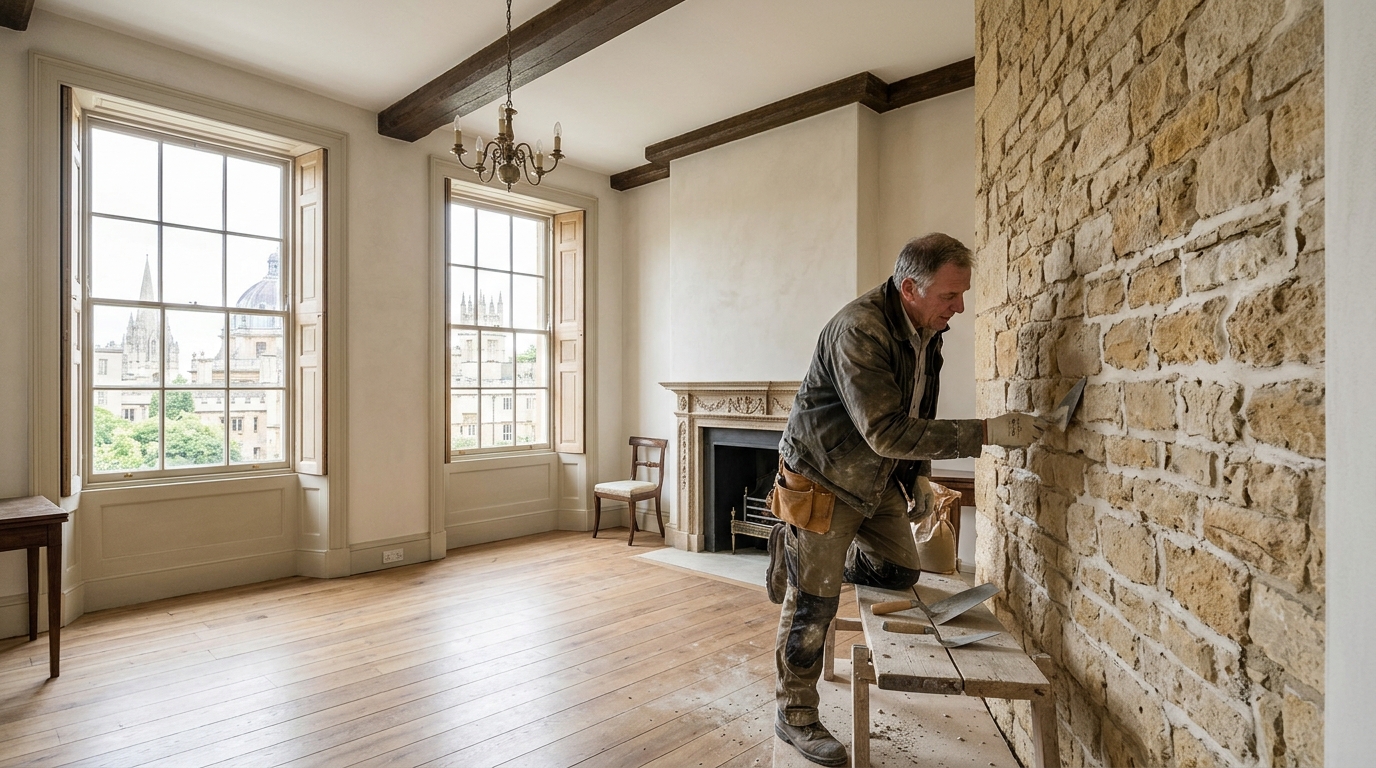
Oxford is home to one of the highest concentrations of Grade II listed residential structures in the United Kingdom—from 18th-century townhouses in St John Street and Beaumont Street to 19th-century villas along Woodstock and Banbury Roads. If you own or intend to renovate a listed property in Oxford:
- Listing covers everything: The myth that “only the exterior facade is listed” is legally incorrect. The listing applies equally to all interior rooms, cellars, roof timbers, curtilage walls, and original fixtures.
- Criminal liability: Unauthorised alteration of a listed building is a strict-liability criminal offence under Section 9 of the Planning (Listed Buildings and Conservation Areas) Act 1990. Lack of awareness is no legal defence.
- Absolute breathability required: Modern Portland cement mortar and gypsum plaster trap moisture, causing Oxford limestone to suffer severe “freeze-thaw spalling”. Traditional hot-mixed lime mortar and hair-lime plaster are non-negotiable.
- 2026 Cost benchmarks: Expect turnkey heritage renovations in Oxford to run between £2,800 and £4,500+ per m² (+ VAT), reflecting specialist hand-craftsmanship and conservation planning.
1. The Legal Framework: Listed Building Consent (LBC) in Oxford
Before swinging a single hammer, stripping wallpaper, or lifting historic pine floorboards, owners of Grade II listed properties must understand the statutory powers wielded by Oxford City Council’s Heritage & Conservation Team.
Under the Planning (Listed Buildings and Conservation Areas) Act 1990, works that “affect the character of a building of special architectural or historic interest” require formal Listed Building Consent (LBC). Unlike standard planning breaches for unlisted buildings—which are usually civil matters and often subject to 4-year or 10-year immunity rules—unauthorised work on a listed building is a strict-liability criminal offence.
Listed building enforcement notices carry no statutory time limit. If a previous owner illegally knocked down an internal chimney breast, removed historic cornicing, or installed modern plastic downpipes in 1998, Oxford City Council can issue an enforcement notice today demanding that the current owner reinstate the original features at their own personal expense.
Works Requiring Listed Building Consent vs. Permitted Maintenance
Homeowners are often surprised by how granular listed building oversight can be. Below is a practical guide to common domestic interventions:
| Proposed Work | Consent Required? | Oxford Conservation Officer Guidance |
|---|---|---|
| Removing or opening up internal walls | Yes (LBC Mandatory) | Requires structural heritage justification. Structural plans cannot permanently destroy historic room proportions. |
| Replacing historic timber sash windows | Yes (LBC Mandatory) | Standard uPVC or thick double glazing will be rejected. Repair is prioritised; ultra-thin vacuum glass (FINEO) evaluated on merit. |
| Repointing external stonework or brickwork | Yes (LBC Mandatory) | Sample panels required. Cement is prohibited. Must match original aggregate, colour, depth, and slaked lime composition. |
| Full electrical rewiring & replumbing | Usually Yes (LBC) | Required if chasing historic walls, notching original joists, or piercing external walls for boiler flues or soil pipes. |
| Replacing modern bathroom or kitchen fittings | Usually No (If Like-for-Like) | Permitted without consent provided service routes remain unchanged and no historic fabric (surrounds, tiles, lath) is damaged. |
| Internal repainting with breathable paint | No | Regular cosmetic decorating does not require consent, provided historic cornices or timber mouldings are not stripped destructively. |
2. The Science of Breathability: Why Portland Cement Destroys Historic Oxford Stone
The single most catastrophic mistake made on Oxford listed buildings is using modern Portland cement mortar for pointing or structural repairs. Understanding why cement fails requires understanding how historic buildings handle water.
Modern homes rely on impervious barriers: cavity walls, damp-proof membranes (DPM), plastic vapor barriers, and silicone sealants to keep water out. By contrast, pre-1919 historic buildings are “breathable” solid-masonry structures. Oxford buildings constructed from porous Headington freestone, Coral Rag rubble, Cotswold oolitic limestone, or local low-fired soft red clay bricks absorb airborne moisture and driving rain, then naturally release it through evaporation once the weather clears.
Lime mortar is soft, pliable, and open-pored. It acts as the “wick” of the wall, allowing moisture to evaporate harmlessly through the mortar joints rather than the stone face.
When a builder repoints with dense, impermeable Portland cement, moisture can no longer escape through the joints. It becomes trapped inside the porous limestone or brick behind the cement ribbon. In winter, this trapped water freezes, expanding by 9% in volume. Because the cement mortar is harder than the historic stone, the expanding ice blows off the decorative face of the stone—a destructive process known as spalling. Within five to ten years, priceless 200-year-old ashlar stonework is irreversibly reduced to dust.
The Crawford Standard: Authentic Lime Formulations for Oxford
At Crawford, our specialist heritage masons select mortar formulations calibrated precisely to the substrate and microclimate of each Oxford property:
- Non-Hydraulic Lime Putty (Air Lime / Fat Lime)Created by slaking calcium oxide with water and maturing it for months. Cures purely through carbonation (absorbing atmospheric CO₂). Exceptionally flexible and vapour-permeable. The gold standard for internal plastering, delicate Headington stone, and soft Georgian internal brickwork.
- Natural Hydraulic Lime: NHL 2 (Feebly Hydraulic) & NHL 3.5 (Moderately Hydraulic)Contains natural clay impurities that allow it to set in damp conditions and gain early compressive strength. NHL 2 is perfect for sheltered Oxford stone facades and soft brick elevations; NHL 3.5 is deployed on highly exposed chimneys, parapet copings, boundary walls, and paving subjected to heavy Oxford rainfall.
- Hot-Mixed Lime MortarsThe traditional practice of mixing kibbled quicklime directly with damp sand. The resulting exothermic reaction produces a warm, sticky, highly workable mortar with micro-pores that offer unsurpassed historic breathability and weather resistance.
3. Restoring Historic Interiors: Lath & Plaster vs. Gypsum Drywall
Many builders gutting period Oxford homes instinctively tear down original lath-and-plaster ceilings and replace them with standard 12.5mm pink fireline plasterboard. In a Grade II listed property, this is both a regulatory violation and an architectural mistake.
Original split-oak or softwood laths bound with animal hair (goat or horsehair) and lime plaster provide extraordinary acoustic buffering, historic character, and microclimatic moisture regulation. Stripping these ceilings without explicit Listed Building Consent is grounds for an immediate Stop Notice from Oxford City Council.
Crawford’s Three-Coat Traditional Lime Plaster System
Where original plaster is sound, we consolidate it from above using conservation plaster washers and specialist adhesives. Where replacement is unavoidable, our master plasterers reinstate authentic three-coat lime work:
Scratch Coat
Coarse sharp aggregate mixed with matured lime putty and teased horsehair. Keyed in a diamond pattern to provide mechanical grip.
Float Coat
Medium sand and lime putty mix applied to create a plumb, true surface while evening out historic wall contours without robotic uniformity.
Setting / Skim
Pure fine silver sand and slaked lime putty troweled to a glass-smooth, velvety sheen ready for breathable mineral paint finishes.
Never apply modern plastic-based vinyl emulsions or oil gloss paints over lime plaster. Plastic paint acts like clingfilm, trapping indoor vapor and causing bubbled paint, mould, and plaster degradation. We specify natural mineral silicate paints (such as Keim), traditional slaked limewash, or plant-based breathable clay paints with vapor diffusion values of Sd < 0.02m.
4. Timber Sash Windows & Historic Joinery: Conservation Standards
Windows are the “eyes” of an Oxford historic property. The delicate glazing bars, handmade cylinder glass, and hand-carved meeting rails of Georgian and Victorian sash windows define the architectural rhythm of streets like Beaumont Street and St John Street.
Oxford City Council enforces a strict “repair-first” hierarchy:
- Joinery Repair & Overhaul: Splicing in new timber (sustainably sourced European oak or durable Accoya) using traditional mortise-and-tenon joints, re-hanging counterweights with waxed cotton cord, servicing original pulleys, and installing concealed perimeter brush draught seals into parting beads.
- Internal Secondary Glazing: Where acoustic insulation against central Oxford traffic noise (e.g. St Giles or High Street) is required, bespoke aluminium secondary glazing with acoustic laminated glass is fitted behind historic timber shutters.
- Ultra-Thin Vacuum Glazing (FINEO / LandVac): Where original sashes are rotted beyond repair, conservation officers increasingly sanction authentic timber sash replication fitted with 6.7mm to 8.3mm vacuum architectural glazing.
Standard double-glazing units are 24mm to 28mm thick. They cannot fit into slender 10mm historic glazing rebates without widening the timber glazing bars from 16mm to 30mm—a modification that ruins historic proportions and is routinely rejected by conservation officers.
Vacuum glass (such as FINEO) uses a microscopic 0.1mm vacuum layer between two sheets of glass. At only 6.7mm total thickness, it achieves a centre-pane U-value of 0.7 W/m²K (outperforming modern triple glazing) while fitting seamlessly into original narrow sash rebates without heavy spacer bars or artificial reflections.
5. Modern Services (M&E) Integration: Heat Pumps, Wiring & Plumbing
How do you bring high-speed data cabling, luxury bathrooms, and modern heat pumps into an 18th-century structure without destroying its character? The foundational heritage principle is Reversibility.
Under English heritage guidance, modern interventions should be designed such that future generations could remove them without permanent loss of the underlying historic fabric.
Instead of chasing vertical conduit channels into delicate historic stone or brickwork, Crawford runs wiring through existing subfloor joist spaces, behind removable heritage skirting boards, inside hollow timber architraves, or via disused historic chimney flues.
Standard concrete or liquid screed UFH traps moisture in solid stone floors, driving rising damp into adjoining perimeter walls. In listed ground floors, Crawford installs breathable lime-screed UFH systems over recycled foam-glass gravel insulation (such as Geocell or Misapor), preserving natural vapor transpiration.
Under statutory planning legislation, air source heat pumps do not enjoy Permitted Development rights on listed buildings. Full LBC and planning approval are required. Units must be discreetly sited in secluded courtyard gardens with acoustic baffles, and external pipework must enter through existing subfloor vents rather than newly bored masonry holes.
6. 2026 Oxford Heritage Renovation Cost Benchmarks
Renovating a Grade II listed property in Oxford commands a premium of 40% to 75% over standard residential renovations. This premium is driven by specialist master trade labor, extended application timelines, and bespoke conservation materials.
Table 1: Whole-House Grade II Renovation Costs per Square Metre
| Specification Tier | Cost per m² (+ VAT) | Typical Scope & Finishes | 150m² Oxford Townhouse |
|---|---|---|---|
| Tier 1: Sensitive Heritage Refresh | £2,200 – £2,800 / m² | Timber sash overhaul & draught-proofing, lime plaster repairs, surface rewiring in voids, mineral paint, new kitchen/bathrooms within existing service runs. | £330,000 – £420,000 |
| Tier 2: Comprehensive Turnkey Renovation | £2,800 – £3,600 / m² | Full external lime repointing, lath-and-plaster ceiling consolidation, new breathable UFH, vacuum glazing, complete M&E overhaul, bespoke architectural joinery. | £420,000 – £540,000 |
| Tier 3: Museum-Grade Structural Restoration | £3,600 – £4,800+ / m² | Structural timber frame splicing, stonework dressing, basement lime-tanking, glass-link contemporary extensions, renewable energy integration, full conservation reporting. | £540,000 – £720,000+ |
Table 2: Specialist Heritage Trade Day Rates in Oxford (2026)
| Specialist Trade / Professional | Oxford Daily Rate / Fee | Key Accreditations / Responsibilities |
|---|---|---|
| Master Stonemason & Lime Pointer | £340 – £420 / day | Hand-raking, bespoke lime putty matching, stone dressing & indenting. |
| Traditional Heritage Carpenter / Joiner | £320 – £380 / day | Historic box sash restoration, timber joist splicing, bespoke cornicing. |
| Traditional Three-Coat Lime Plasterer | £310 – £370 / day | Horsehair lath-and-plaster, ornamental fibrous plaster mouldings. |
| Accredited Conservation Architect / Surveyor | £900 – £1,300 / day | RIBA / RICS Conservation register, Heritage Statements, LBC filings. |
| Vacuum Glazing Supply & Installation | £1,200 – £1,650 / sash | FINEO / LandVac slimline unit installation into existing historic timber beads. |
While the historical 0% VAT relief for listed building alterations was removed in 2012, homeowners can still capitalise on substantial tax savings under HMRC Notice 708:
- • 5% Reduced VAT Rate: If the listed Oxford property has been completely empty and unoccupied for at least 2 continuous years prior to the start of renovation work, qualifying building services and materials supplied by Crawford qualify for 5% VAT instead of standard 20%.
- • 0% Zero-Rate VAT: Applies if renovating a listed building that has been derelict or empty for 10+ years, or converting a commercial/agricultural building into residential dwellings.
On a £450,000 comprehensive renovation contract, the 5% VAT empty-property concession saves an Oxford homeowner approximately £67,500 in tax.
7. Step-by-Step Oxford Listed Building Consent Roadmap
Successfully navigating the Oxford City Council conservation approval cycle requires a structured, multi-phase methodology:
Crawford surveys the building, reviewing Historic England archives, historic Ordnance Survey maps, and original architectural features to determine what elements carry high, moderate, or neutral significance.
We present outline proposals to the dedicated Oxford Conservation Officer. Early alignment on window strategies, structural openings, and service routing avoids costly refusals during formal determination.
Submission of detailed architectural 1:10 and 1:20 joinery sections, Schedule of Works, Structural Engineer impact notes, and a comprehensive Heritage Statement. Statutory decision window is 8 weeks.
Consents almost always include pre-commencement conditions. Crawford prepares on-site 1m² sample lime mortar pointing panels and joinery prototypes for in-person sign-off by the conservation officer before main building works begin.
Master trades execute the approved scope with continuous photographic logging. Upon completion, a comprehensive Heritage Archive and Building Control Completion Certificate are handed over to safeguard future property value.
Frequently Asked Questions: Listed Renovations in Oxford
Clear answers to the most common legal, architectural, and financial questions regarding Grade II listed building work in Oxford.
Crawford Heritage Advisory
Historic Building Surveyors & Master Masons
Crawford Construction specialises in sensitive heritage conservation, lime mortar masonry, and complex Grade II listed restorations across Oxford, Jericho, Summertown, and Oxfordshire villages.
Oxford Heritage Checklist
- Verify listing entry on Historic England database
- Check for Article 4 Directions in Oxford City Council Conservation Area
- Commission Heritage Significance Statement before submitting designs
- Confirm 100% lime mortar and breathable paint specification
- Verify 5% VAT eligibility under HMRC Notice 708
Related Oxford Guides
- Full House Renovation Cost in Oxford (2026)
- Period Home Renovation in Conservation Areas
- Party Wall Agreements: Oxford Surveyor Guide
- Victorian Terrace Extensions in Oxford
- Cellar Tanking & Waterproofing Oxford
- Architect vs Design & Build Contractor
- Case Study: Grade II Listed Oxford Townhouse
- Crawford Heritage Renovation Services
Let's build
somethingremarkable.
From first sketch to final handover — Oxfordshire's trusted team for homes built with precision, craftsmanship and care.